

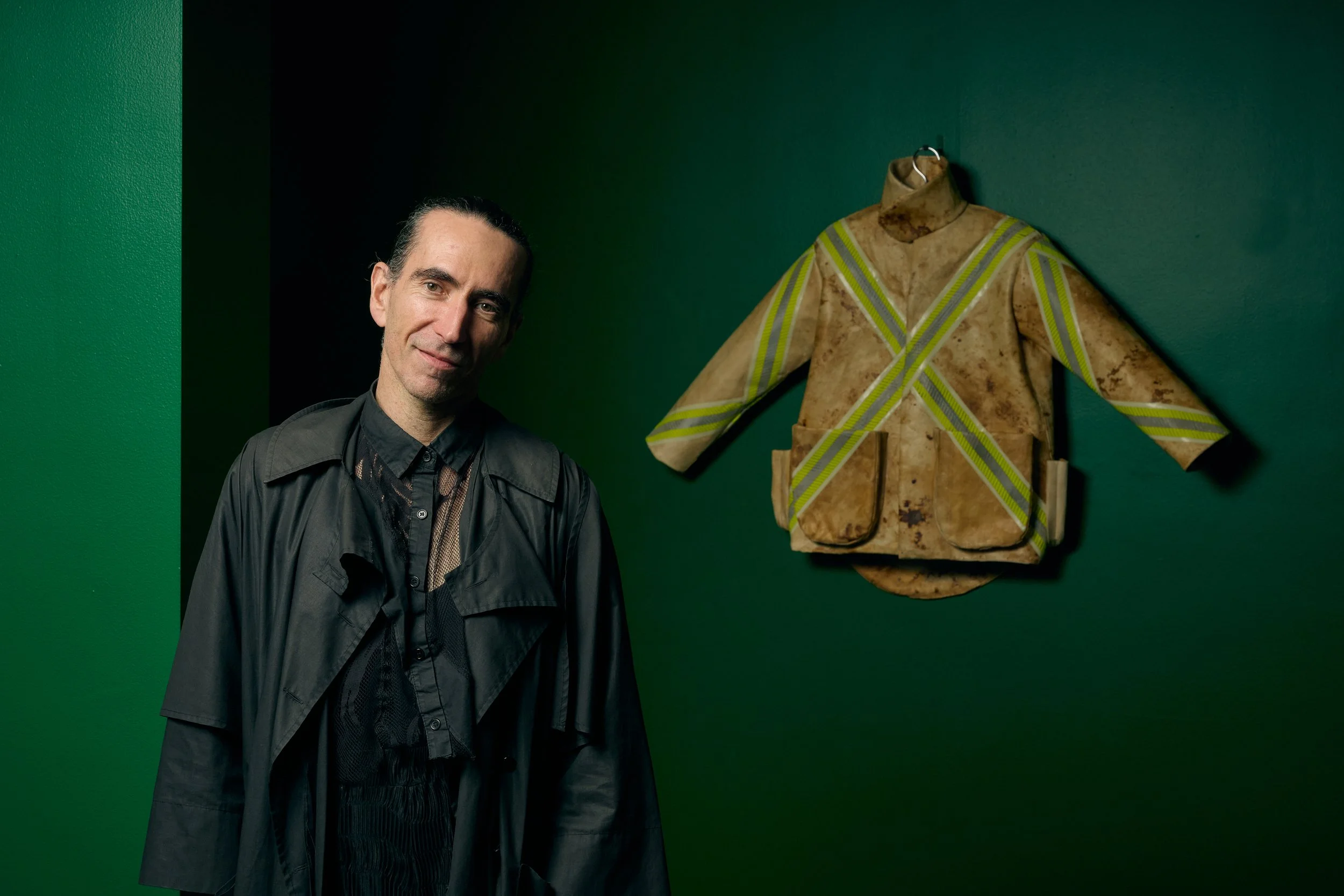
Portrait of Alexi Freeman with Mycelium Wildfire Jacket in Plant Life: The Nature of Design, on display from 28 August 2026 - 7 February 2027, The Ian Potter Centre: NGV Australia, Melbourne. Photo: Eugene Hyland.
MYCELIUM WILDFIRE JACKET
While firefighters are among the first human responders to wildfires, fungi are among the first ecological responders, helping landscapes recover through decomposition, nutrient cycling and regeneration.
Mycelium Wildfire Jacket explores the potential of fungi-grown materials for future protective clothing. I designed and fabricated this prototype to investigate what protective clothing might look like when we begin with biology rather than petrochemicals — translating an emerging biomaterial into a wearable garment.
The jacket is fabricated from mycelium leather grown from a Polypore macrofungal type, cultivated using agricultural waste, water and controlled growing conditions. Unlike conventional synthetic materials, mycelium does not readily ignite or melt when exposed to heat; its fungal structure can char rather than ignite, contributing to its natural thermal and fire-resistant properties. Ongoing research is investigating its durability, fire resistance, thermal insulation and capacity to self-extinguish when exposed to flame.
The material used for the project has achieved OEKO-TEX® STANDARD 100 Product Class II certification and has been independently screened for a broad range of substances, including PFAS, formaldehyde, heavy metals and phthalates.
Developed through a collaboration between RMIT designers and material scientists, the project brings together Dr Judith Glover, Dr Tien Huynh, PhD candidate Mohamad Arekha Bentangan and bio-designer Alexi Freeman, with assistance from intern Flora Bellemo.
As a prototype, the jacket explores both the potential and the current limitations of fungi-grown materials. The fabrication process became an ongoing dialogue with the material itself, requiring the garment's design and construction to respond to the particular dimensions, thicknesses and behaviour of the mycelium sheets.
The project ultimately asks: what might protective clothing become if it were grown from biological systems rather than manufactured from petrochemical-based materials?
There is also a poetic reciprocity at its heart: a firefighter's jacket, designed to protect humans from wildfire, grown from an organism that plays an important role in ecological recovery after fire.
Exhibited in Plant Life: The Nature of Design, The Ian Potter Centre: NGV Australia, 28 August 2026 – 7 February 2027.